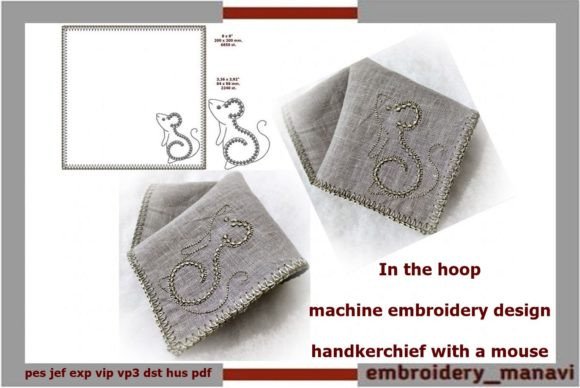
ITH Handkerchief with a Mouse
As a commercial embroidery designer who works daily with small business owners, makers, and branded merchandise creators, I often look at digital embroidery files through a very specific lens: will this design sell? Will it hold up on a cap, apron, or tote bag? Does it carry enough personality to become a brand asset without compromising stitch quality? The ITH Handkerchief with a Mouse landed in my review queue, and I immediately saw a charming, handcrafted feel that could work beautifully for a specific kind of small business—if used with the right technical approach.
At first glance, the design is undeniably sweet. The image of a tiny mouse peeking out from a folded handkerchief feels like a nod to storybook illustrations, slow living, and thoughtful handmade presents. It’s not aggressive or loud, which means it won’t overpower a brand logo but could serve as a delicate accent, a sleeve detail, or a standalone patch for a boutique line. The “in the hoop” nature adds a clever construction element that can elevate the perceived value of the finished product. For a business owner wondering if this belongs in their embroidery file library, the short answer is yes—but let’s talk about how to make it work commercially.
First Impressions: A Soft, Story-Driven Design
When I open a machine embroidery design like this, I'm not just looking at the preview—I'm mentally testing thread colors, imagining how it stitches out on textured fabric, and asking whether it reads well at a distance. The ITH Handkerchief with a Mouse has a gentle, narrative quality. It’s not modern or minimalist; it’s rustic, warm, and slightly nostalgic. The handkerchief motif itself suggests a homemade, heirloom aesthetic, which makes the design ideal for businesses that trade in comfort, care, and personality. Think a small bakery, a florist, a children’s boutique, a pet shop, or a creative studio that uses a mouse as a mascot.
However, because it leans heavily into “cute,” the design won’t suit every brand. A tech startup or a sleek urban clothing line might find it too whimsical. But for a handmade brand, an Etsy seller, or a local café that wants to stitch a friendly touch onto aprons or tea towels, this design feels like a perfect fit. The mouse detail is the focal point, and the handkerchief adds a sense of place, almost like a tiny framed scene. This framing can help the design feel complete even when used as a small embroidered patch.
Business Use Cases: Where This Design Shines
Small business owners often ask me: “Can I use this one design on multiple products?” With the ITH Handkerchief with a Mouse, the answer is a solid yes, provided you test thoroughly. Here’s where I see it performing best:
- Embroidered patches for boutique merchandise. This design is practically begging to be finished as a standalone patch. The handkerchief shape creates a natural border, so you can easily trim, seal, and attach it to jackets, tote bags, or even product packaging. A patch like this, attached to a kraft paper hang tag, instantly elevates a handmade item.
- Apron and uniform accents for warmth-driven businesses. A café, bakery, or homestyle restaurant could use this design on a chest pocket or apron bib. It adds a personal, welcoming touch without being a loud logo. Customers remember small details like an embroidered mouse on a server’s apron.
- Cap and beanie details for niche brands. While the full design might be too large for a structured cap front, a reduced version—or even just the mouse element isolated—could work on the side or back of a cap. For a pet brand, a children’s bookshop, or a gardening supply store, a tiny embroidered mouse on a cap brim becomes a signature mark.
- Tote bag corner branding. Instead of a large central design, place this in the bottom corner of a canvas tote. It’s unexpected, charming, and looks intentional. For an Etsy seller who ships orders in reusable totes, this turns the bag into a gift itself.
- Customer thank-you gifts and packaging accents. Stitch the design onto a small fabric tag, a mini handkerchief, or a sachet. Include it with orders as a surprise. The “handkerchief” theme ties directly to the idea of care and thoughtfulness, which reinforces a brand’s message.
In each of these applications, the ITH Handkerchief with a Mouse acts as a brand asset, not just decoration. It tells a story. For a business that sells experience and emotion as much as product, that’s incredibly valuable.
Where to Use This Design With Care
Not every embroidery file translates perfectly to every surface. With this design, there are a few scenarios where you’ll need to exercise extra caution—or even reconsider—before stitching.
Small patch sizes. The mouse and handkerchief detail likely rely on fine lines and small satin stitches. If you shrink the design too aggressively, those details may disappear or become dense, bulletproof patches that pucker and feel stiff. Always test at the intended size before committing to a production run. If the mouse’s whiskers or the handkerchief folds become muddled, you may need to simplify or use a lighter thread weight.
Curved surfaces like cap fronts. The design’s rectangular composition (handkerchief with a central mouse) can struggle on a highly curved cap crown. The embroidery file may cause distortion, and the handkerchief’s straight edges might warp. Consider using it on flatter cap areas—like the side, back, or a soft unstructured cap—instead.
Tiny lettering (if included). The product description doesn’t mention text, but if the design includes any small lettering, be wary. Letters under 4mm often lose clarity in embroidery. If there’s any text as part of the handkerchief detail, verify it reads clearly on your test stitch-out.
High stitch density on lightweight fabrics. A dense design on a thin t-shirt or delicate blouse can cause puckering. Use a proper cutaway stabilizer, and consider using a topper on textured fabrics like fleece or terry cloth. The handkerchief folds might have overlapping stitches—test on a similar fabric before running a batch.
Dark uniforms and high-contrast threads. If your brand colors are dark, the mouse might need to be stitched in a light thread to pop. However, light thread on dark fabric can show every tiny gap and misalignment. Do a black-and-white test stitch first to see if the design holds its shape without relying on color alone.
How This Design Shapes Brand Identity
When a small business chooses an embroidery file like the ITH Handkerchief with a Mouse, they’re not just picking a pretty picture. They’re adding a visual element that will appear on products, uniforms, and packaging, and that element will influence how customers perceive the brand. This design reads as friendly, handcrafted, and approachable. It doesn’t scream corporate or mass-produced. Instead, it whispers “care,” “story,” and “attention to detail.”
For a business that prides itself on artisan methods, locally sourced ingredients, or personal service, this design reinforces those values. A florist who wraps bouquets in tissue and adds a tiny embroidered sticker or patch with this design is telling the customer: “We think about the little things.” A bakery that stitches this onto flour sack towels sold alongside their bread creates a cohesive brand experience that goes beyond the loaf itself.
However, if your brand is all about sleek minimalism, high-tech efficiency, or edgy streetwear, this design might actually work against you. It’s too soft, too narrative. Visual consistency matters. Before purchasing any digital embroidery file, ask yourself: does this design feel like it belongs in the same world as my logo, my packaging, and my language? For the right brand, the ITH Handkerchief with a Mouse will feel like it was made for them.
Practical Embroidery Designer Notes for Business Owners
I run through the same checklist for every commercial embroidered project, and I recommend you do the same. Here are the steps I’d take before putting this design into production for a client or your own small business:
- Test in black and white first. Remove all color from the equation. Stitch a sample using only black thread on white fabric. This reveals whether the design relies on color contrast for legibility. If the shapes are still clear, you’re off to a great start.
- Check if it works at a small patch size. In the hoop projects often have a fixed size, but you might need to scale down for a patch. Ask the digitizer or test at 75%, 60%, and 50% of the original size. Look for thread breaks, lost details, and dense spots.
- Review thread color contrast. The handkerchief and mouse likely benefit from subtle shading. I’d test two or three color palettes—one matching your brand, one neutral, and one high-contrast—to see which version best communicates the design.
- Inspect spacing and stitch direction. Look closely at the handkerchief folds. Do they overlap cleanly? Are there any gaps between the mouse and the handkerchief? Even small gaps can expose fabric, and on a dark base, that’s a problem.
- Confirm hoop size and stabilizer needs. The product description doesn’t specify hoop size, so always check the file requirements before purchasing. An in-the-hoop design often requires a specific hoop. Use a firm cutaway stabilizer for most applications, and add a water-soluble topper for textured fabric.
- Test on the actual fabric you’ll use. Cotton canvas, denim, performance polyester, and fleece all behave differently. A design that stitches perfectly on quilting cotton might pucker on a thick apron. Don’t skip this step.
- Create a printable mockup for client approval. If you’re stitching for a client, place the design on a digital mockup of the final product. Show placement options. This prevents miscommunication and ensures the client understands scale and impact.
- Compare it beside other design assets. If you’re building a brand’s embroidery library, stitch this design next to your logo, other motifs, or text elements. Do they feel like a family? Cohesion matters.
- Confirm commercial licensing before business use. Always check the seller’s terms. Some digital embroidery files are for personal use only, while others allow commercial use on finished products. Never assume; always verify.
Using the ITH Handkerchief with a Mouse for Branded Merchandise: A Real-World Scenario
Imagine a small artisan pet brand called “Whisker & Leaf.” They sell handmade dog bandanas, catnip toys, and botanical-themed treats. Their brand voice is warm, earthy, and slightly whimsical. They want to add a small embroidered patch to their best-selling linen bandana. The patch needs to be subtle, not a big logo, but something that makes their product instantly recognizable.
The ITH Handkerchief with a Mouse fits perfectly. The mouse is on-theme, the handkerchief suggests the kind of careful folding and packaging they do, and the design is distinct enough that customers will start to associate that little embroidered scene with the brand. The pet brand stitches it out at 2.5 inches wide, uses earthy olive and cream threads, and heat-seals it onto the bandana corner. The result is a premium, handmade feel that competitors can’t easily copy. It’s not just a bandana anymore; it’s a Whisker & Leaf bandana.
That’s the power of a well-chosen embroidery file. It becomes part of the product’s identity, not just an add-on. The ITH Handkerchief with a Mouse has that potential, but it requires a business owner who understands how to blend technical care with creative vision.
Final Thoughts for the Commercial Embroiderer
As someone who stitches for a living, I know that not every beautiful design translates to a profitable product. The ITH Handkerchief with a Mouse is a strong candidate for any business that values charm, storytelling, and a handcrafted aesthetic. It’s not a universal “staple” design like a simple monogram or a bold geometric logo, but for the right brand, it can be the kind of detail that turns a one-time buyer into a loyal customer.
Take the time to test it. Adjust thread colors to match your brand palette. Experiment with placement. And always think about the finished product from the customer’s perspective. If that little embroidered mouse brings a smile and communicates care, then you’ve done your job as a commercial embroiderer. The ITH Handkerchief with a Mouse is a design that can do exactly that, and I’ll be adding it to my own library of go-to files for client projects that need a touch of gentle, story-driven embroidery.